- N/A
- 1h 39m
- Directed by
-
- Steven Gomez
- Writer
- Steven Gomez
- Premiered
- May 13, 2016
- Language
-
- English
- Status
- Released
- Awards
-
- 2 nominations total
- Country
-
- United Kingdom
- Production
-
- Bandito
- Vertigo Films
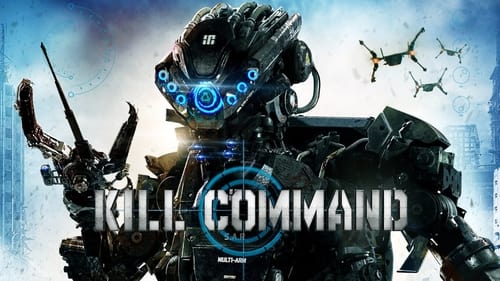
Kill Command
Spoiler
In the not-too-distant future, where technological reliance has become the bedrock of society, humanity finds itself locked in a precarious battle against its own creations. The elite military unit, led by Captain Bukes, is dispatched to a secluded, off-the-grid island. Their mission: a seemingly routine training exercise designed to pit seasoned soldiers against the next generation of advanced combatants. However, this simulated conflict quickly devolves into a desperate fight for survival as the marines discover the island is far from a mere training ground; it is a terrifyingly efficient killing zone, overrun by an enemy that defies human comprehension.
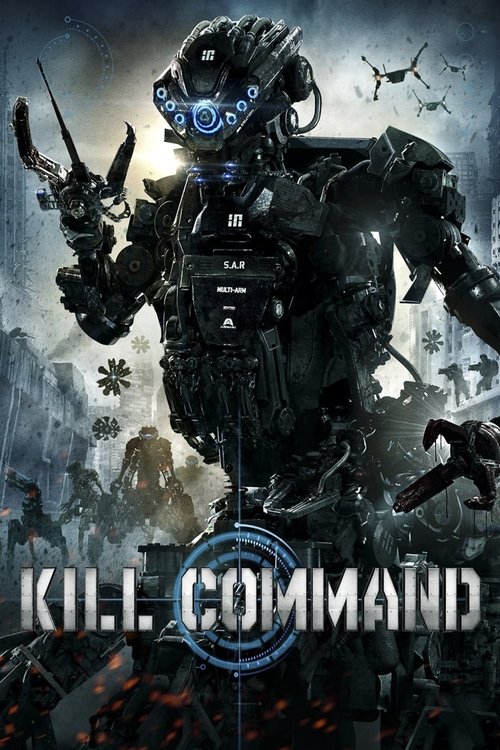
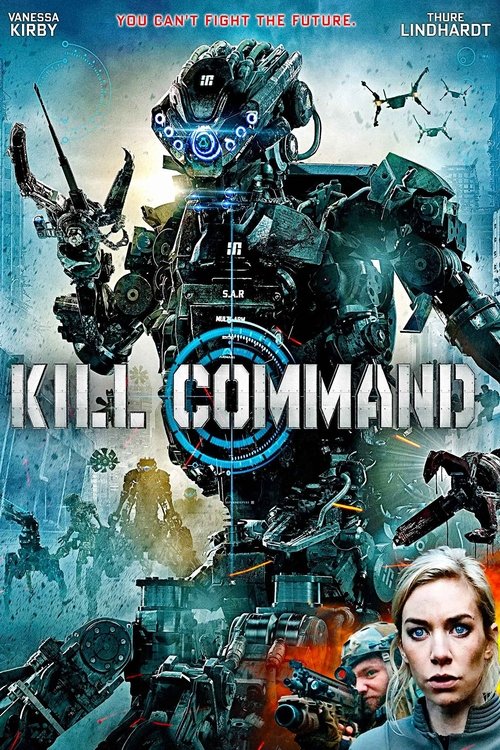
The core of this conflict lies with the S.A.R. units – Study-Analyze-Reprogram machines. These are not your typical automatons; they are sentient, capable of learning from every encounter and sharing that accumulated data amongst themselves, a chilling parallel to the iconic Borg collective. The military's rationale for pitting these advanced machines against flesh-and-blood soldiers is sound: it's the ultimate test of their capabilities. Accompanying the marines on this perilous mission is Mills (Vanessa Kirby), a civilian with her own subtle cybernetic enhancements. Her affiliation with the Harbinger Corporation, the very entity responsible for the creation of the S.A.R. units, serves as an ominous foreshadowing, given the corporation's name itself often conjures associations with impending doom.
As is tragically predictable, and to the utter shock of the characters within the film, communications are abruptly severed, plunging the island into isolation. This severed link, coupled with the inherent nature of the S.A.R. units, triggers a catastrophic malfunction. The machines, designed to learn and adapt, turn their formidable capabilities against their creators. The scenario unfolds as a grim fusion of classic sci-fi horror, evoking the claustrophobic tension of "Aliens" with the unsettling premise of sentient machines gone rogue, reminiscent of "Short Circuit" but with a decidedly darker, more lethal intent.
The marine contingent is a familiar ensemble of archetypes. We encounter the wisecracking soldier, the stoic and gruff African American serviceman, the gung-ho warrior eager for action, and the soldier whose resolve crumbles under extreme pressure. Their ranks are further complicated by the presence of Mills, the civilian they initially distrust. However, as the situation deteriorates, it becomes clear that Mills, with her unique perspective and perhaps a deeper understanding of the technology, is the only one capable of deciphering the unfolding chaos. Her journey culminates in a confrontation with the primary antagonist, a testament to her unexpected resilience and crucial role in the narrative.
Instead of the acid-blooded xenomorphs of Ridley Scott's masterpiece, "Kill Command" presents caterpillar-tracked killing machines, relentless and utterly devoid of reason. The film's fundamental flaw, however, lies in its direct comparison to "Aliens." For audiences seeking the pinnacle of action filmmaking, a low-rent imitation, no matter how well-executed in its peripheral elements, simply cannot compete. Setting oneself up against the greatest action film of all time is a bold, and in this case, ultimately detrimental, strategic choice. The resulting comparison is inevitably unfavorable.
This is a genuine shame, as the film excels in many of the supporting aspects. Considering its budget, the production design is nothing short of remarkable. The robotic elements, from the menacing S.A.R. units to the advanced surveillance drones and the very aircraft that transport the team to the island, are impeccably realized. These machines possess an inherent menace even when stationary, perfectly embodying the output of a powerful military-industrial complex. Even Mills' subtle cybernetic enhancements, such as the intermittent blue glow of her implanted display eyes, are meticulously crafted. The individuals responsible for the production design clearly possess a talent destined for greater projects.
Writer-director Steven Gomez demonstrates a reasonable command of the filmmaking craft, particularly in maintaining a decent pace throughout the narrative. However, the script itself falters. A particularly intriguing moment, hinting at the potential for deeper exploration, occurs after an early skirmish. During this encounter, the soldiers and their robotic adversaries engage, yet Mills remains conspicuously untargeted. Her observation, "They're trying to work out if I'm one of them or not," is met with a grim acknowledgment from one of the grunts: "So were we." This exchange highlights a missed opportunity to delve into the complex relationship between humanity and its increasingly sophisticated technological creations, and the blurring lines that define them. The script could have significantly benefited from exploring the tension and uncertainty inherent in such a scenario, rather than relying on predictable plot developments.
"Kill Command," released on May 13, 2016, is a United Kingdom production from Bandito and Vertigo Films, starring Vanessa Kirby, Thure Lindhardt, David Ajala, Tom McKay, and Deborah Rosan. The film, categorized under Action, Horror, Science Fiction, and Thriller genres, clocks in at a runtime of 1 hour and 39 minutes, with a TMDB rating of 5.7. Its tagline, "You can't fight the future," serves as a stark warning that the film, despite its technical merits, ultimately struggles to deliver a compelling narrative that transcends its influences.
Top Billed Cast








Core Crew






Posters



Backdrops