- PG-13
- 1h 44m
- Directed by
-
- Clint Bentley
- Novel
- Denis Johnson
- Premiered
- November 05, 2025
- Language
-
- English
- Status
- Released
- Budget
- $10,000,000.00
- Awards
-
- 1 win & 3 nominations total
- Country
-
- United States of America
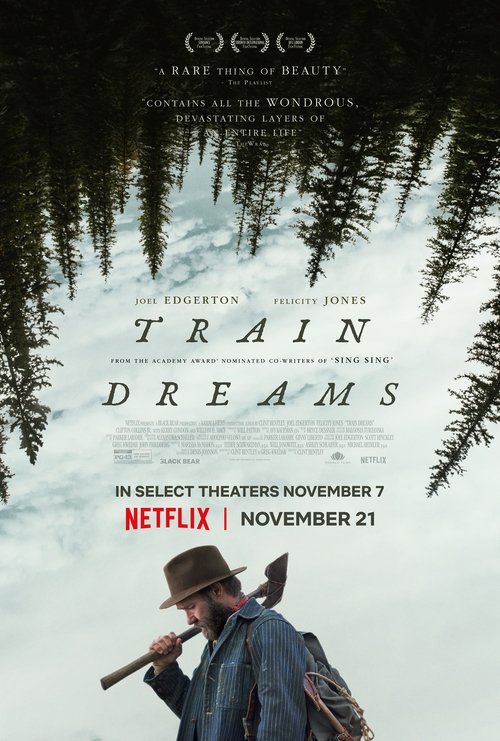
Train Dreams
- Production
-
- Kamala Films
- Black Bear Pictures
Spoiler
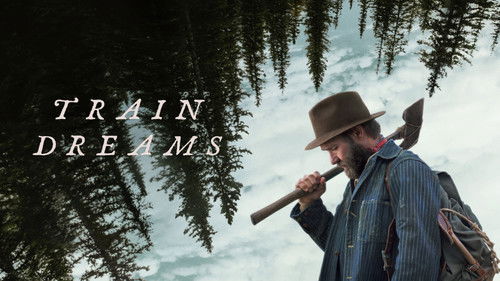
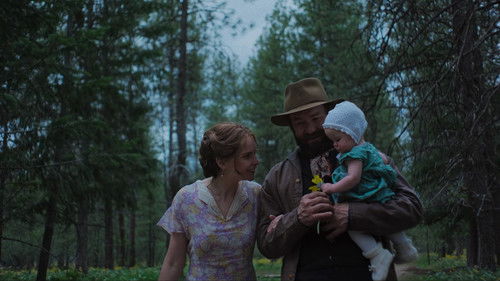
Netflix's "Train Dreams," a cinematic adaptation of Denis Johnson's poignant 2011 novella, has quickly captured the attention of viewers, becoming one of the most talked-about films following its early November 2025 release. Directed by Clint Bentley and starring a compelling Joel Edgerton, this drama unfolds as a quiet epic, charting the life of Robert Grainier, a logger whose existence is irrevocably altered by a devastating loss. The film masterfully weaves a narrative tapestry of love, grief, guilt, and the enduring search for peace, set against the backdrop of a transformative era in early 20th-century America.
At its core, "Train Dreams" is a deeply personal story about Robert Grainier, a man who embodies a powerful allegory for the human condition. Edgerton delivers a nuanced performance, portraying Robert's internal struggles with profound authenticity. The supporting cast, including Felicity Jones, Kerry Condon, William H. Macy, and Will Patton, contribute to the film's rich characterizations, each playing a vital role in Robert's journey. The narrative, while grounded in a seemingly simple premise, is augmented with creative twists that leave audiences pondering its layers of meaning long after the credits roll.
The film's setting is crucial to its thematic resonance. Primarily taking place in the early 1900s, "Train Dreams" also serves as a chronicle of the fading embers of a specific period in American history, a time of monumental change and burgeoning industrialization. This historical context amplifies the personal drama, highlighting the vast shifts occurring both in the nation and within Robert's own life.
The ending of "Train Dreams," much like the moments leading up to it, is deliberately ambiguous, inviting multiple interpretations. While the final sequence is relatively straightforward to follow, the film leaves it unclear precisely how Robert arrives at this conclusion and whether alternative paths were ever truly within his grasp. The narrative reveals that Robert ultimately dies alone in the cabin he painstakingly rebuilt, a structure that replaced the original consumed by a forest fire decades prior.
Interspersed with this final image, the film illustrates how Robert has been caught in a temporal loop, seemingly unable to escape the moment he discovered his wife and child were missing, presumed lost in the blaze. For the latter half of the movie, Edgerton's character clings to the fragile hope that his family might have simply left town, rather than perishing in the inferno. However, his deepest yearning for their return is never definitively satisfied.
Despite never fully forgiving himself for his absence during the devastating fire, "Train Dreams" eventually depicts Robert making a tentative effort to reintegrate into society. The film doesn't explicitly state the year when Robert is seen walking through the streets of Spokane. However, a broadcast he observes in a television store window appears to be live footage of John Glenn's historic 1962 orbital flight aboard the Friendship 7 spacecraft. This strongly suggests that the film's flash-forward sequence is set in 1962.
This specific historical moment is not chosen arbitrarily. It serves as a powerful reflection of the conclusion of Robert's arduous journey. Just as Glenn breaks free from Earth's gravity to orbit his home planet, Robert, too, has battled unseen obstacles and found a way to begin shedding the weight of his trauma, striving to embrace the remaining time he has. He translates this newfound, passive realization into action by taking to the skies in a small plane, attempting to emulate Glenn's elevated perspective.
As Robert seems on the verge of absolving himself of years of accumulated guilt, "Train Dreams" introduces an emotional curveball by bringing his daughter, Kate, back into the narrative. Believing she was long gone, Robert is understandably overjoyed to discover a more mature Kate (portrayed by Zoe Rose Short) unconscious but alive outside his cabin. After tending to what appears to be a broken leg, Edgerton's character drifts off to sleep while watching over his daughter. Upon waking, he finds an open window and an empty bed. Despite a thorough search of the surrounding area, Robert finds no further trace of Kate.
The film strongly implies that this entire experience was a manifestation of Robert's psyche, a product of his final stages of grief. However, "Train Dreams" doesn't entirely dismiss the possibility that Kate might have somehow survived and sought out her father in his time of need, only to depart before dawn. While this scenario is presented as unlikely, the more probable interpretation is that this version of Kate exists solely within Robert's mind.
One compelling theory suggests that Kate's "reappearance" is a subconscious response to Robert's apparent readiness to move forward with his life. The late arrival of Kerry Condon as Claire Thompson in the film's final half-hour positions her as a potential romantic interest for Robert. The two kindred spirits share a palpable chemistry, both defaulting to isolation in the wake of profound loss. Robert makes a rare overture, reaching out to Claire, who briefly serves as a confidante, allowing Edgerton's character to gently lay his grief to rest by articulating his tormented thoughts.
Kate's return occurs almost immediately after this interaction between Robert and Claire. This timing leads to the argument that Robert's subconscious might be resisting another chance at happiness, harshly reminding him that the fate of his daughter and wife remains unresolved. This emotionally charged hallucination, delivered as a final flicker of hope, ensures that Robert's focus remains tethered to his trauma, rather than shifting towards a future with Claire, a future his ailing mind likely deems him unworthy of. It's a somber theory, but one that aligns seamlessly with the film's central themes.
Alfred Hsing plays a pivotal, albeit brief, role in "Train Dreams." Early in the film, Robert witnesses Fu Sheng, a fellow railroad worker from Shanghai, being forcibly removed and thrown from the bridge they helped construct, resulting in his fatal plunge. The motive behind this brutal act remains undisclosed, and Robert is unable to intervene. He even appears to momentarily assist the men dragging Fu Sheng away. Despite his demise, Fu Sheng continues to manifest, but only to Robert.
Fu Sheng becomes the spectral embodiment of Robert's profound regret. Edgerton's character begins to internalize the belief that he is undeserving of happiness due to his inaction in the face of such apparent injustice. Fu Sheng never speaks to Robert during these hauntings; he simply stares. His apparitions coincide with Robert's darkest moments, serving as a projection of Robert's subconscious seeking an explanation or justification for the dire turns his life has taken. Essentially, Robert grapples with the notion that he is working through a karmic debt accumulated by standing by while Fu Sheng met his end.
Fu Sheng's spectral visits eventually cease, suggesting that Robert feels he has endured sufficient penance. However, the dissolution of his guilt over Fu Sheng's death does not entirely cleanse his spirit. Robert continues to torment himself for a considerable period after Fu Sheng's final appearance, intensifying his focus on the loss of his wife and child, and questioning if he could have done more to save them or search for them more diligently. The self-forgiveness Robert ultimately bestows upon himself in his final years offers him the most authentic and fulfilling ending that "Train Dreams" can provide.
"Train Dreams" is a powerful exploration of the human capacity for enduring pain and the arduous path toward acceptance. It's a film that lingers, prompting reflection on loss, memory, and the quiet strength found in confronting one's deepest regrets.
Top Billed Cast








Core Crew






Posters






Backdrops